26 May 2010

Jenny Burns


Witham Radio & Photographic documents
Jenny Burns

Witham Radio & Photographic documents an ex-photography shop in South West London. The series explores obsolescence, memory, and the decline of analog photography.

Established in 1970, the business once thrived on its sales of analogue photography supplies, film processing and camera repairs. In the late 1980’s the shop ceased its involvement with photography.
All of the images in the series were taken on out-of-date film from the shop, which expired between 1991 and 1994. www.jenniferburns.co.uk

Marianne Bjornmyr


41 Horizons
Marianne Bjornmyr

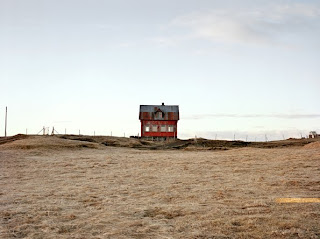
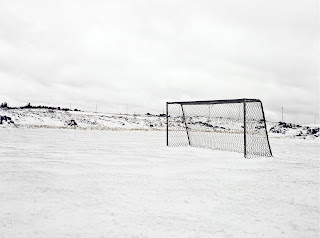
The project 41 Horizons aims to investigate on subjects of notions of space - belonging and development in the mythological landscapes and culture of Iceland. The island remains in astonishing natural flux, and variations can be seen in the landscape, created by the power of the nature. Within the varied environments of the island, hidden creatures inhabit stones, trees waterfalls and mountains: elves, fairies, gnomes, light-fairies, mountain spirits, and Iceland’s own ‘Huldufolk’. 53 percent of Icelanders either believe, or no dot deny, the existence of that the hidden creatures and their dwellings and great consideration for the other beings is taken when building and developing in the environment. The camera has here been used as a tool in the process of exploring the relationship between humans and the hidden creatures in the landscapes of the island. The images are used as a documentation of what is there, but are not necessarily duplicating the reality of what was in the space at that time. The images display juxtaposition between the landscapes, fantasy, culture and myth; the boundaries that challenges the human perception makes us question the space around us, our space in the world.

‘One can actually photograph everything that can be photographed. The imagination of the camera is greater than that of every single photographer and that of all photographers put together. This is precisely the challenge to the photographer’ (Flusser, in Towards a Philosophy of Photography, p. 20).

Michael Cripps


Michael Cripps

Michael Cripps’ take on the street photograph aims to explore the viewers’ interaction with the structure of the photograph, as well as photography’s intrinsic dialogue with cinema. His series, shot from an unconventional angle, allows the relation between each figure and its surroundings to become disrupted; the reader cannot assume or position said figures into an environment. The unique view of the street results in large areas of black and the ambiguous nature of night. This lack of depth leads to a questioning of the space, a two-dimensional field in which the characters never perhaps ‘belonged’, moving in and out of frame. The cinematic feel develops from the use of flash, combined with the angle it acts as a spotlight, as if these transitory figures are on the theatre stage.

Zoe Martin


Place writing: Beyond location and subjectivity
Zoe Martin

‘In the work of a great many writers who aim to rehabilitate place as a central theoretical concept, place is thus distinguished from mere location through being understood as a matter of the human response to physical surroundings or locations.’
(Malpas, 1999:30)

Areas of history, culture and personal experience inform how we read photographs, and this is different for each person. Furthermore in a photograph, for each person, a place is created: places of memory, adventure, safety or distress - though not always literally. Landscapes have long been known as affective places.
The experiences created by the places discovered in landscape could be seen as one way the affective turn is formed. (Phu & Steer 2009:235-240) Martin's project endeavours to explore these ideas.

Grace Haughton


The Great British Power Shift

Grace Haunghton

“The Great British Power Shift” is a project set within the borders of Britain and focuses on the way our society is changing and developing in response to current environmental issues. As a series it explicitly refers to nature and industry whilst implicitly depicting the ideology behind cultural and social movements for a greener environment that has greatly affected our national identity. This project stemmed from an interest and research into global initiatives such as the Kyoto Protocol.

Charlotte Price


After Jack
Charlotte Price

Between August and November 1888, the Whitechapel area was host to brutal murders each linking back to the killer dubbed “Jack the Ripper”. This piece of work aims to analyses the economical and political factors that have affected the human relationship to this landscape. Through the concept of Psychogeography, following Merlin Coverely’s idea of walking the urban environment as “an act of subversion”, the landscape filmed provides evidence that human interaction with a urban environment is difficult to maintain. This film documents a structured route around Whitechapel, filming each murder sites, and demonstrating the lack of human interaction that can be gained from each landscape through the process of urbanisation.

Alison Nash


The Tainted Tales

Alison Nash

The series is taken from three fairy tales, Cinderella, Red Riding Hood and Alice In Wonderland, 'The Tainted Tales' was subjected to interpretations, analysis and exposed to western cultural aspects, social relevance and incorporating psychological sadistic overtones to create an unheimlich aura surrounding the photographs to produce the adult versions of the these tales.
The tales illustrate, Cinderella subjected to psycological dominance from her own mother, Red Riding Hood depicted as the young male unable to fight his attraction for an older more powerful experienced woman who uses her sexuality to lure him, defining the western social aspect that women are becoming more independent, dominant and predatory. And Alice In Wonderland expresses the notion of western cultural delinquency and peer pressure seen in adolescence.